How Are We Justified?
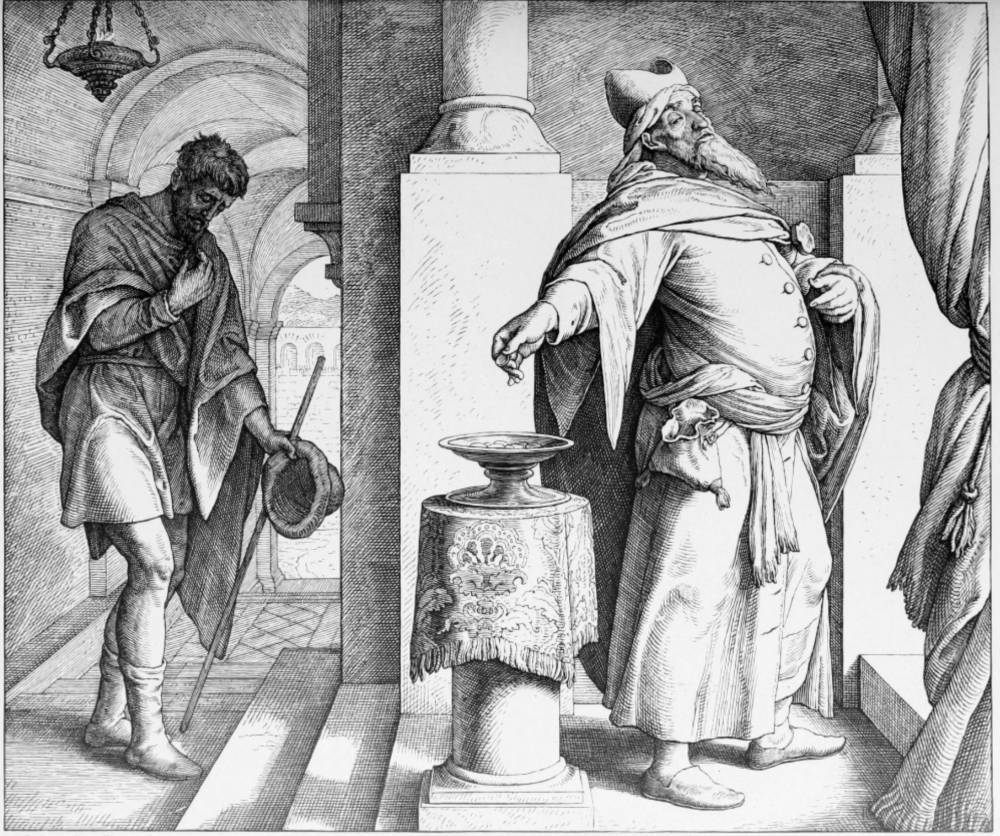
When Jesus tells the story of two men who go up to the temple in Jerusalem to pray, He relays two prayers that couldn’t be more different. One man, a Pharisee, prays:
God, I thank you that I am not like other people – robbers, evildoers, adulterers – or even like this tax collector. I fast twice a week and give a tenth of all I get. (Luke 18:11-12)
The tax collector, to whom the Pharisee refers in his prayer, is the other person who prays at the temple that day. His prayer consists simply of:
God, have mercy on me, a sinner. (Luke 18:13)
In his prayer, the Pharisee compares himself to other people and judges himself better than them. The tax collector compares himself to God and finds himself infinitely lacking, so he asks for mercy from Him. The Pharisee believes he is like God and unlike other sinners. The tax collector confesses he is utterly unlike God and worse than other sinners.
After describing these two prayers, Jesus declares:
I tell you that this man, rather than the other, went home justified before God. (Luke 18:14)
Jesus says that the tax collector, and not the Pharisee, leaves the justified before God. Why? Because the tax collector looked to the righteousness of God to justify him. The Pharisee only looked at the sinfulness of others and justified himself compared to them. The Pharisee tried to justify himself before God by using others. The tax collector realized if you want to be justified before God, you need to be justified by God.
It is far too easy to try to justify ourselves like the Pharisee tried to justify himself by using others. But true justification comes not by using others, but by trusting Jesus. May we find our justification in the right place – which is in the Righteous One.
When Knowledge Isn’t Power

It was Francis Bacon who ostensibly was the first to say, “Knowledge is power.” Whoever actually said it first, it’s been repeated many times – and it’s been believed for much longer than it’s been said.
When Satan shows up in the Garden of Eden, he tempts Adam and Eve with nothing less than knowledge. He tries to get them to eat fruit from a tree that God has forbidden, because it will open their eyes to the knowledge of not only good, but also evil. But Satan says this knowledge will also give them power:
God knows that when you eat from it your eyes will be opened, and you will be like God, knowing good and evil. (Genesis 3:5)
Satan implies that if Adam and Eve can gain the knowledge of God, that will give them power over God. And they fall for it. But instead of gaining power, their new knowledge instead results in death.
One of the wisest men who ever lived, King Solomon, sternly warns against gossip:
The words of a gossip are like choice morsels; they go down to the inmost parts. (Proverbs 18:8 and 26:22)
We are still enticed by gossip, however. Why? Because we believe that knowledge about someone may afford us power over someone. From blackmail to shaming to even manipulating someone with knowledge we know about them that they don’t know we know about them, we still believe knowledge is power. But, like Adam and Eve, such knowledge often leads to nothing but death – death in our relationships, death in our trust of another person, and the death of our ability to talk to someone rather than about someone.
Satan gossiped about God to Adam and Eve and look where it led them. There are some things that are simply none of our business. We don’t need to know. In a culture that loves to know, sometimes, ignorance isn’t just bliss; it’s holy. So, let’s reject gossip about others. For by rejecting gossip about others, we can know God better. And He’s someone we do need to know.
God Talking to Himself about You

When God creates the plants, fish, and land animals in Genesis 1, He speaks to the land and water He has already created to bring these creatures forth:
Let the land produce vegetation: seed-bearing plants and trees on the land that bear fruit with seed in it, according to their various kinds. (Genesis 1:11)
Let the water teem with living creatures. (Genesis 1:20)
Let the land produce living creatures according to their kinds: the livestock, the creatures that move along the ground, and the wild animals, each according to its kind. (Genesis 1:24)
God calls to the land to produce plants and animals and to the water to produce fish. Why? Because the land is where plants and animals belong and the water is where fish belong.
And yet, when God creates human beings, things change. Rather than speaking to the land, where we will live, God speaks to Himself:
Let us make mankind in Our image, in Our likeness, so that they may rule over the fish in the sea and the birds in the sky, over the livestock and all the wild animals, and over all the creatures that move along the ground. (Genesis 1:26)
If the land is where humans will live and belong, why doesn’t God call to the land to bring them – to bring us – forth? It’s because ultimately and in a very unique way, we don’t belong to the land, but to God. We are created in His image:
God created mankind in His own image, in the image of God he created them; male and female he created them. (Genesis 1:27)
Yes, we will live on the land. And yes, the first man Adam is even created from the ground. But he belongs – and we belong – to God.
This is why Adam’s fall into sin in Genesis 3 is such a tragedy. He goes from belonging to God to wanting to be like God, which shatters his relationship with God. But God does not give up. Through the prophet Jeremiah, He envisions a time when:
“This is the covenant I will make with the people of Israel…” declares the Lord. “I will put My law in their minds and write it on their hearts. I will be their God, and they will be My people. No longer will they teach their neighbor, or say to one another, ‘Know the Lord,’ because they will all know Me, from the least of them to the greatest,” declares the Lord. “For I will forgive their wickedness and will remember their sins no more.” (Jeremiah 31:33-34)
God will make sure we belong to Him. We will be His people. He will be our God.
God loves you so much that, when He created you, He had a conversation with Himself about you. You belong to Him. And nothing can change that.
On Pet Rocks

During the Christmas season of 1975, the gift to get was a pet rock. Marketed as “genuine” and “pedigreed,” and sold at $4 a rock, this fad made its originator, Gary Dahl, a millionaire. The fad didn’t last, though, because even though pet rocks are very low maintenance, they don’t do what other real pets do. They won’t purr when you pet them like a cat. They won’t follow you around the house like a dog.
But what if one did?
The apostle Paul summarizes Israel’s journeys through the wilderness when writing to the Corinthians:
For I do not want you to be unaware, brothers, that our fathers were all under the cloud, and all passed through the sea, and all were baptized into Moses in the cloud and in the sea, and all ate the same spiritual food, and all drank the same spiritual drink. For they drank from the spiritual Rock that followed them, and the Rock was Christ. (1 Corinthians 10:1-3)
Wait, a rock followed Israel through the wilderness?
Paul is alluding to two stories that serve as bookends for Israel’s wanderings in the wilderness. In Exodus 17, at the beginning of the Israelites’ journey, Moses strikes a rock at Horeb and water pours out of it for the people to drink. Then, in Numbers 20, Moses also strikes a rock, though God had commanded Moses to speak to the rock this time, and water again pours out.
Paul picks up on these two stories and surmises that there must have been one water-filled rock following Israel around through the wilderness. But the real key comes in his identification of that rock: “the Rock was Christ” (1 Corinthians 10:3). Israel’s rock was much more than just a pet. It was a person – the same person who said:
Let anyone who is thirsty come to Me and drink. Whoever believes in Me, as Scripture has said, rivers of living water will flow from within them. (John 7:37-38)
Jesus, Paul declares, followed Israel through the wilderness – providing for them, caring for them, and ultimately, being gracious to them.
When we experience our own wilderness moments – when our souls feel dry and our lives feel difficult – we can rest assured that we have a Rock who follows us into even the driest and most treacherous moments of our lives to water our parched souls and comfort us by His presence.
Our Rock is Christ.
“Was Blind, Which Is How I See”
I still remember when I really began to notice and be annoyed by it. It was when I was a sophomore in high school. When my algebra teacher was writing equations on the chalkboard, I couldn’t help but squint and wonder: “Did she just write a 7 or a 9? And is that a 3 or an 8?” At first, I wanted to blame it on her sloppy chalkmanship. But when it wasn’t just my algebra teacher’s writing, but my English teacher’s, my science teacher’s, and my social studies teacher’s writing too, I was forced to admit to myself that perhaps my eyesight wasn’t what it used to be. So, begrudgingly, I trudged off to the optometrist. And I got a prescription for glasses.
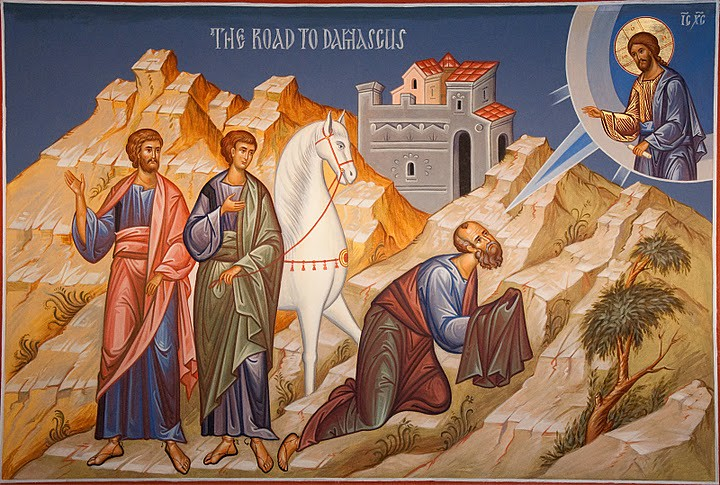
I had never paused to think about just how precious being able to see clearly was until I began not to be able to see! So, you can imagine how devastating it must have been for a man named Saul who, while on a trip to Damascus, had a light from heaven flash around him and a voice from heaven speak to him only to find out that, when this supernatural experience was over, he couldn’t see: “Saul got up from the ground, but when he opened his eyes he could see nothing” (Acts 9:8).
It turns out that the light blinded him was from none other than Jesus and the voice that spoke to him was none other than that of Jesus. Saul, up to this point in his life, had made it his mission to persecute those who claimed Jesus was the Messiah. He believed that Jesus was nothing but a man who was pulling a scam. But when Saul encounters Jesus enthroned in heaven, his mind quickly changes. He goes from believing Jesus was a fraud to believing that Jesus is God. But it all happened when Saul became unable to see. Paradoxically, this is when Saul began to see Jesus for who He was most clearly.
What was true for Saul is true for us. Sometimes, when we feel like life has gone dark and we cannot see – these become the moments when we see Jesus most clearly. When the darkness of a dreaded diagnosis overtakes us – we see Jesus as our only hope for healing most clearly. When a relationship falls apart despite our best efforts and our hearts go dark – we see Jesus as our only possibility for reconciliation and restoration most clearly. Even when we close our eyes in death and everything we have ever seen or ever known goes dark – this is when we see Jesus as our resurrection and our life most clearly.
John Newton famously wrote that, because of Jesus’ amazing grace, I “was blind, but now I see.” Sometimes, however, it’s not our blindness that must be removed so we can see, it’s our blindness that helps us see. Because when we can see nothing because everything has been taken from us, all we have left is Jesus. And it’s at these moments when we, just like Saul, can truly see – and trust in – Him most clearly.
The Clergy Crisis

Over the past several days, I have had multiple conversations about clergy who have fallen from their positions in disgrace and sin. Hearing such stories always breaks my heart because such clergy often wind up victimizing those for whom they are called to care and scandalizing the Church.
Sadly, this kind of crisis is nothing new. In Leviticus 8 and 9, God instructs Moses to appoint and ordain priests to offer sacrifices to God on behalf of Israel. Everything begins well. When Aaron, the first high priest of Israel, offers an ox and a ram to God:
Fire came out from the presence of the Lord and consumed the burnt offering and the fat portions on the altar. And when all the people saw it, they shouted for joy and fell facedown. (Leviticus 9:24)
But the joy of Israel does not last for long. In the very next verse, we read:
Aaron’s sons Nadab and Abihu took their censers, put fire in them and added incense; and they offered unauthorized fire before the Lord, contrary to His command. So fire came out from the presence of the Lord and consumed them, and they died before the Lord. (Leviticus 10:1-2)
These two priests did not carry out their duties faithfully, but contrarily to what God had commanded. And they paid dearly for it. From almost the very moment the clergy was instituted, they sinned and created a crisis.
When two brothers, Cain and Abel, offer sacrifices to God, God is pleased with Abel’s sacrifice, but rejects Cain’s. Cain becomes incensed and begins to plot to kill his brother. God, knowing what was in Cain’s heart, warns him:
If you do what is right, will you not be accepted? But if you do not do what is right, sin is crouching at your door; it desires to have you, but you must rule over it. (Genesis 4:7)
Sometimes, sin seems most enticing at the very moment one is doing something spiritual – whether offering a sacrifice like Cain, or leading a church like a pastor. The religious leaders of Jesus’ day are the archetypes of this temptation. Those who appeared to be the most spiritual were also deeply sinful. As Jesus says of them:
Woe to you, teachers of the law and Pharisees, you hypocrites! You are like whitewashed tombs, which look beautiful on the outside but on the inside are full of the bones of the dead and everything unclean. In the same way, on the outside you appear to people as righteous but on the inside you are full of hypocrisy and wickedness. (Matthew 23:27-28)
Ultimately, what we have seen among many clergy should serve as a warning to us all. Outward spirituality does not automatically indicate inward sanctification. For the sake of the Church, may we pray for those who lead us – that they would lead well. And may we pray for ourselves as well. Whether we are leading worship services are attending them, Satan plants sin at our door. Thankfully, at just the moment Satan seeks to lure us through that door into sin, Jesus steps in and says:
I am the door. (John 10:7)
He is the One who can rescue us – all of us – from our sin. This is why, in the Church, we trust in Him.
When God Won’t Meet With You

The book of Exodus ends with a theological tragedy. Throughout the book, God has been powerfully present among His people – when He rescued them from Egypt by sending plagues on Egypt, when He went ahead of them in a pillar of cloud by day and a pillar of fire by night, when He led them through the Red Sea, when He fed them manna from heaven, and when He gave them the Ten Commandments. On the heels of all this, God gives to Moses instructions on how to build the tabernacle, which is also called the Tent of Meeting. The purpose of the Tent of Meeting is explicit in its name – it is a place to meet with God. But when it is completed, something startling and unsettling occurs:
The cloud covered the Tent of Meeting, and the glory of the Lord filled the tabernacle. Moses could not enter the Tent of Meeting because the cloud had settled on it, and the glory of the Lord filled the tabernacle. (Exodus 40:34-35)
Upon its completion, the Tent of Meeting is immediately closed for, well, meeting. Moses cannot go into the tent. This is how the book of Exodus ends.
The book of Exodus, then, ends with a crisis. Israel’s sins – among which have been grumbling and idolatry – have separated her from God. God’s dream and desire that He “might dwell among them” (Exodus 29:46) seems lost.
But then, the book of Leviticus opens:
The Lord called to Moses and spoke to him from the Tent of Meeting. (Leviticus 1:1)
Just when it seems like Israel has been cut off from God, He speaks. He reaches out. And what follows in Leviticus is a set of instructions on how Israel might interact with Him. God has not given up His hope of being with them:
I will put My dwelling place among you, and I will not abhor you. I will walk among you and be your God, and you will be My people. (Leviticus 26:11-12)
Have you ever felt cut off from God? Have you ever felt like you cannot dwell with Him or like He will not dwell with you? Have your prayers ever gone unanswered? Has God ever felt distant? Each time you feel like you’re stuck at the end of Exodus, Leviticus is waiting. God will speak. God will reach out. He wants to be with you. Don’t believe me? Just look at Jesus.
Take Your Sin to the Right Place

One of the most tragic stories in Scripture is that of Judas Iscariot – the one who betrayed Jesus into the hands of His enemies and, ultimately, His executioners for a pitiful pittance of 30 pieces of silver. Shortly after Judas leads the Jewish religious leaders to Jesus so they can arrest Him, he is overwhelmed by the anguish of his guilt:
When Judas, who had betrayed Him, saw that Jesus was condemned, he was seized with remorse and returned the thirty pieces of silver to the chief priests and the elders. “I have sinned,” he said, “for I have betrayed innocent blood.” “What is that to us?” they replied. “That’s your responsibility.” So Judas threw the money into the temple and left. Then he went away and hanged himself. (Matthew 27:3-5)
Judas’ actions against Jesus are treacherous and wicked. But this does not make his end any less tragic.
Part of what makes Judas’ end so devastating is that he understood the gravity of his actions and began looking for a path to redemption. He rushed back to the ones who had paid him the paltry sum of silver and confessed:
“I have sinned,” he said, “for I have betrayed innocent blood.”
But the religious leaders only lobbed his sin right back on him.
“What is that to us?” they replied. “That’s your responsibility.” (Matthew 27:4).
“That’s your responsibility.” These are the most damning words anyone can speak to any sinner. They remove every hope for redemption, restoration, or reconciliation. This is why it is so important that we not only feel remorse over our sin, but take our sin to the right person.
I have often wondered what would have happened if Judas would have taken his confession to Jesus. How would Jesus have responded? Here’s my guess:
“Judas, you mean the world to Me. I’ll take your sin to the very place to which you betrayed Me. But it is no longer your responsibility.”
Are you overwhelmed by remorse, guilt, or shame? Take it to Jesus – no matter what it is. He will take it from you and, in exchange, give you freedom, forgiveness, and righteousness.
One more thing: if you, like Judas, struggle, for whatever reason, with thoughts of taking your own life, seek help. Whatever it is that is leading you into these thoughts, Jesus wants more for you. Jesus wants life for you. He died so that you can live.
Knowing Thyself

On the Temple of Apollo at Delphi, there is inscribed a famous maxim: “Know thyself.” But knowing one’s self can be hard. Solomon writes, “The purposes of a person’s heart are deep waters” (Proverbs 20:5). In other words, we often don’t understand our own hearts – our own selves. Or, as the apostle Paul puts it: “I do not understand what I do” (Romans 7:15).
Knowing thyself is key. After all, if we do not understand ourselves – including our hidden motives and perverse incentives – it will be very difficult for us to love others rather than use them. So, what is the key to knowing ourselves better?
Scripture gives us some critical practices to help us know ourselves. The first is that of confession, or self-examination. In confession, we grapple with what we know we’ve done wrong – those things that nag us with guilt and regret. The lie we told. The lust we indulged. The addiction we engaged. The person we hurt. Confession brings the parts of ourselves we would rather pretend not to know into the light. It is the first step to knowing ourselves.
But there is more. For we need not only confession, but counseling, or cross-examination. Oftentimes, our motives are so mixed, or our sin becomes so opaque to us, that we cannot see it for what it is. We become strangers to ourselves. We have all had the experience where we offended someone, often justifiably, and we did not even know it because we did not see how our words or actions hurt others. Those who counsel us – and not just professionally, but as friends, spouses, and neighbors – can help us identify our blind spots. After Solomon writes, “The purposes of a person’s heart are deep waters,” he adds, “but one who has insight draws them out” (Proverbs 20:5). We need people of insight around us to draw out what we cannot ferret out for ourselves.
Both of these practices can help us know ourselves. But, of course, knowing yourself is quite different than liking yourself. When we become aware of the depth of our brokenness and sin, it can be easy to fall into despair or self-loathing. This is why one more practice is needed – that of compurgation.
Compurgation was an early common-law method of trial in which a defendant could be acquitted on the endorsement of friends or neighbors. In other words, if enough people interceded for someone who had been accused of a crime, he could be exonerated on his friends’ testimony.
The apostle Paul asks:
Who is the one who condemns? No one.
Paul says that no one can condemn us in our sin. Why? Because:
Christ Jesus who died – more than that, who was raised to life – is at the right hand of God and is also interceding for us. (Romans 8:34)
Christ is the one who testifies on our behalf. And His testimony is all we need to be exonerated by being forgiven through Him. His compurgation is enough.
So then, who are we? We are children of God through Christ. We are sinners by nature, yes. But we are also saints through faith. How do we know this? By knowing ourselves – and, even more importantly, by knowing Christ.
Two Kinds of Self-Righteousness

In our society, little is more despised than someone who is “self-righteous.” No one, it seems, wants to be someone or likes anyone who fits the stereotype of a self-righteous person – proud of their own moral success and judgmental of those who they judge to be morally inferior. And yet, as much as we may despise self-righteousness, we still fall prey to it, often without even knowing it. Self-righteousness, it turns out, is sneaky.
One way that many people have sought to address the scourge of self-righteousness is by dismissing the notion any ultimate righteousness. In this way of thinking, if someone does something you would consider “wrong,” it is excused by calling it “right for them.” Righteousness gets relegated to the realm of personal preference.
But this, too, is its own form of self-righteousness. After all, when we say righteousness is defined by what is “right for me,” we are defining righteousness for ourselves, which, by definition, is self-righteousness.
What Christianity offers is not a righteousness that judges others, but nor is it a righteousness that we create for ourselves. Instead, it is a righteousness that is given freely through Christ. As the apostle Paul writes:
Righteousness is given through faith in Jesus Christ to all who believe. (Romans 3:22)
The Christian does not self-righteously condemn and judge others because Jesus did not condemn and judge him. Instead, He forgave him. But the Christian also does not make up the rules as he goes, for what matters is not what is right for him, but what is right to Jesus. His righteousness is what the Christian looks to for guidance and for salvation. The only true antidote to self-righteousness, then, is Jesus’ righteousness.
His is a righteousness worth sharing.


 Pastor Zach's Blog